
Stage 3 | Focus Groups
PhD research | Women in Israeli high-tech
Research access only.
Incorrect password. Try again.
PhD research | Women in Israeli high-tech
Research access only.
Incorrect password. Try again.
Multi-stage PhD research on barriers to women's advancement in Israeli high-tech | Stage 2 findings and discussion materials
Three stages, one question: what blocks women's advancement in Israeli high-tech, and what can actually work?
| Stage | Method | N | Status |
|---|---|---|---|
| Stage 1 | In-depth interviews | 19 women in Israeli high-tech | Complete |
| Stage 2 | Quantitative survey (GBSWL) | 220 women in Israeli high-tech | Complete |
| Stage 3 | Focus groups (strategy development) | ~20 women, 3-4 groups | You are here |

Service in elite technology units is not merely a career credential. It is the sector's primary social sorting mechanism. Founding teams, VC networks, and senior recruitment pipelines are seeded from unit alumni networks. Women were excluded from many elite technical tracks for years, and even after formal exclusion ended, the prestige hierarchy it created remains structurally intact.
Israelis enter the workforce later than global peers: 2-3 years of mandatory service means typical entry at age 25-26. Career acceleration then compresses into the window of 28-35, the same years as peak caregiving load. The promotion cliff and the parenthood moment land simultaneously.
Israeli high-tech operates in permanent urgency mode. The "always available, full mobility" norm was built by people without domestic obligations and continues to be the benchmark. Long hours, evening availability, and spontaneous business travel are encoded in promotion criteria as signals of commitment and leadership. The cost of this culture falls asymmetrically on anyone who carries a second shift.
47 items measuring 9 barrier mechanisms. Each item rated 1-5 (strongly agree to strongly disagree). Higher score = stronger barrier.
| # | Mechanism | Items | Mean |
|---|---|---|---|
| M1 | Employment Capital & Access | 8 | 3.41 |
| M2 | Performance-Recognition Gap | 10 | 2.76 |
| M3 | Leaky Pipeline | 3 | 1.61 |
| M4 | Male-Default Organization | 6 | 2.83 |
| M5 | Hostility Spectrum + Queen Bee | 7 | 2.39 |
| M6 | Bias Awareness Dynamics | 2 | 3.00 |
| M7 | Legacy Norms in New Organizations | 3 | 1.41 |
| M8 | Motherhood Penalty | 1 | 2.74 |
| M9 | Strategic Self-Suppression | 6 | 3.17 |
| Finding | What it means |
|---|---|
| M1 | Employment Capital & Access: beta=-0.405*** (p<.001) on career optimism | Strongest predictor in multivariate model; survives FDR correction |
| M9 | Strategic Self-Suppression: Item 11 | 73.4% top box | Most endorsed item of 47, but M9 does not predict outcomes; it is a response to other mechanisms |
| M2 | Performance-Recognition Gap: rho=-0.50 with advancement vs. men | Strongest bivariate correlation with career progression |
| M5 | Hostility Spectrum + Queen Bee: p=0.029 by domain | Only mechanism with a significant statistical split: Biz/Ops > Core Tech |
Why this question, why Israel, why now.
Israeli high-tech is one of the world's most concentrated technology ecosystems, yet a persistent gender gap widens at every level of seniority. The funnel below compares the Israeli pipeline against the global high-tech average.
Source: Israel Innovation Authority, 2025
| Common Diagnosis | What Stage 2 Found Instead |
|---|---|
| "The pipeline is thin" | M3 (leaky pipeline at entry) has the lowest mean of all 9 mechanisms among women already in tech. Survivorship, not thinning. |
| "More mentorship solves it" | M1 shows that the problem is sponsorship and access networks, not mentorship. Women learn to lead alone (Item 27, M=3.80, 68% top box). |
| "Hostile environments are the issue" | M5 is not the top predictor. M1 (access capital) and M9 (self-suppression tax) dominate the regression model. |
Click any mechanism to open the full card with data, quotes, and intervention table.

Women in Israeli high-tech are typically technical high-performers, but structurally isolated. They are less likely to receive meaningful mentoring, less likely to have a sponsor advocating for their next move, and more likely to have had to learn to lead entirely alone. The result is not a skills gap. It is an access gap.
«היו לי גם מנהלים טובים, שניסו לקדם אותי — אבל זה היה נדיר»
"I had good managers who tried to promote me, but that was rare."
— Survey participant, Stage 2
| Item / Factor | Mean | Top box |
|---|---|---|
| Item 27: "I had to learn to lead entirely on my own" | 3.80 | 67.9% |
| Item 26: "I had a female mentor" (reverse) | 3.58 | 59.6% have none |
| Item 29: "A leader sponsored me for promotion" (reverse) | 3.30 | ~51% no sponsor |
| Item 23: "Male colleagues socialize without me" | 3.00 |
| Outcome | beta | p (FDR) |
|---|---|---|
| Career optimism | -0.405 | <0.001 *** |
| Number of promotions | -0.293 | 0.034 * |
| Advancement vs. men | -0.158 | 0.109 (trend) |
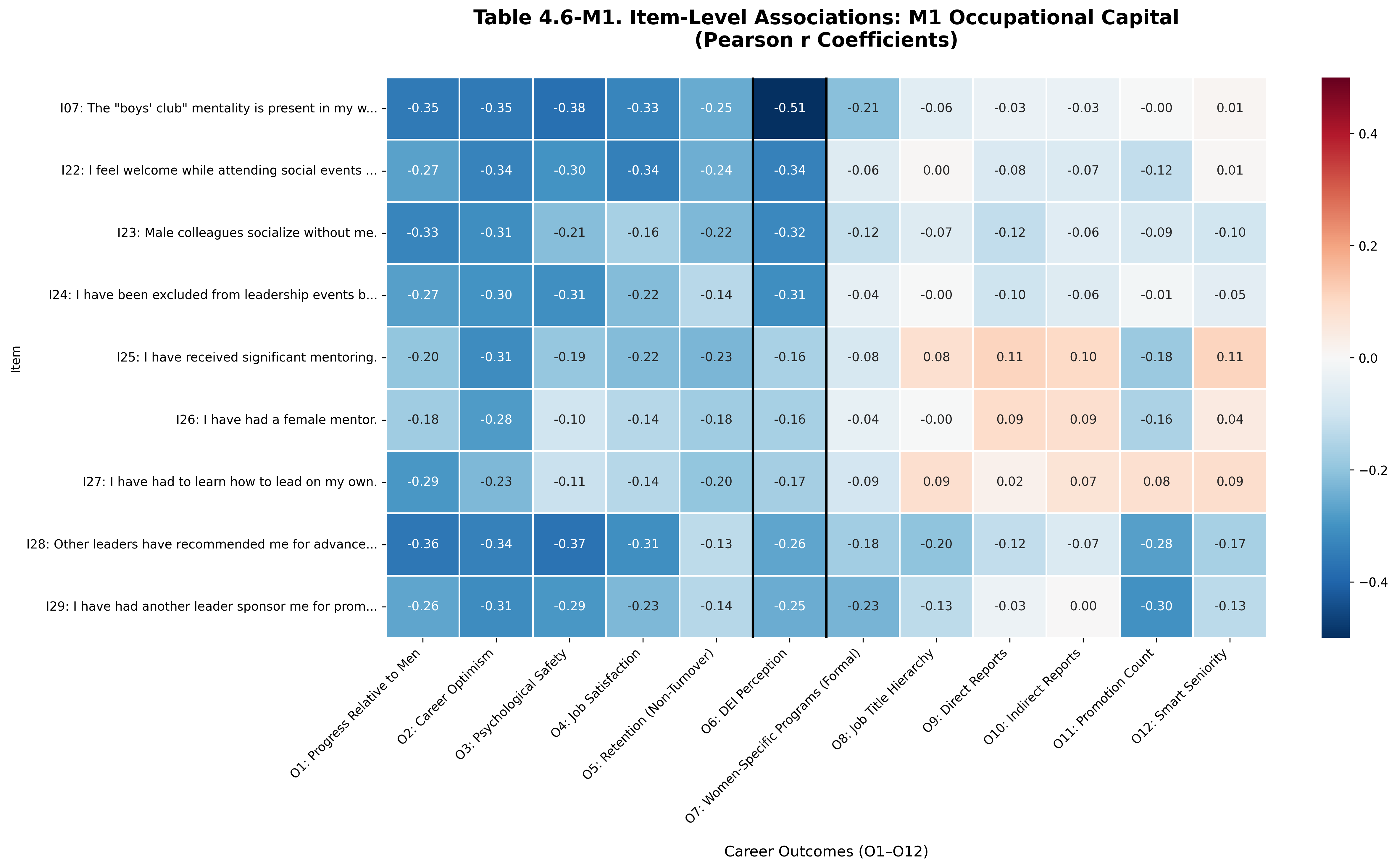
Women in this sample are not failing to perform. The problem is that performance does not translate into recognition, credit, promotion, or pay. The gap between women's contributions and what they receive in return is the strongest factor associated with constrained career advancement across all nine mechanisms.
«חוויתי מקרים שבהם חסמו בפניי תפקידים ניהוליים, למרות שהיה תקן פתוח והפגנתי יכולות»
"I experienced cases where management roles were blocked to me, despite there being an open headcount and my having demonstrated capability."
— Survey participant, Stage 2
«האופן המובלע שבו אנחנו תמיד יותר ביקורתיים על נשים ותמיד סלחניים לגברים»
"The implicit way we are always more critical of women and always forgiving of men."
— Survey participant, Stage 2
| Item | Mean | Top box |
|---|---|---|
| Item 34: "I earned less than male peers" | 3.26 | 42.7% |
| Item 21: "I worked harder for the same credibility" | 3.06 | 44.0% |
| Item 18: "My ideas are taken seriously when a man echoes them" | 2.94 | 39.5% |
| Item 20: "I am expected to be nurturing at work" | 2.85 | 34.5% |
Women who advocate assertively for their work are penalized for violating communal norms. Women who stay communal are less visible and receive less credit. Neither path leads to reliable recognition.
| Category | Share |
|---|---|
| Total tech workforce | 33.5% |
| R&D roles | 26.5% |
| Senior managers (VP+) | 17.6% |
| Startup CEOs (past decade) | 10.6% |
| Capital raised by women-led companies | 4.3% |
Source: Israel Innovation Authority, 2025.
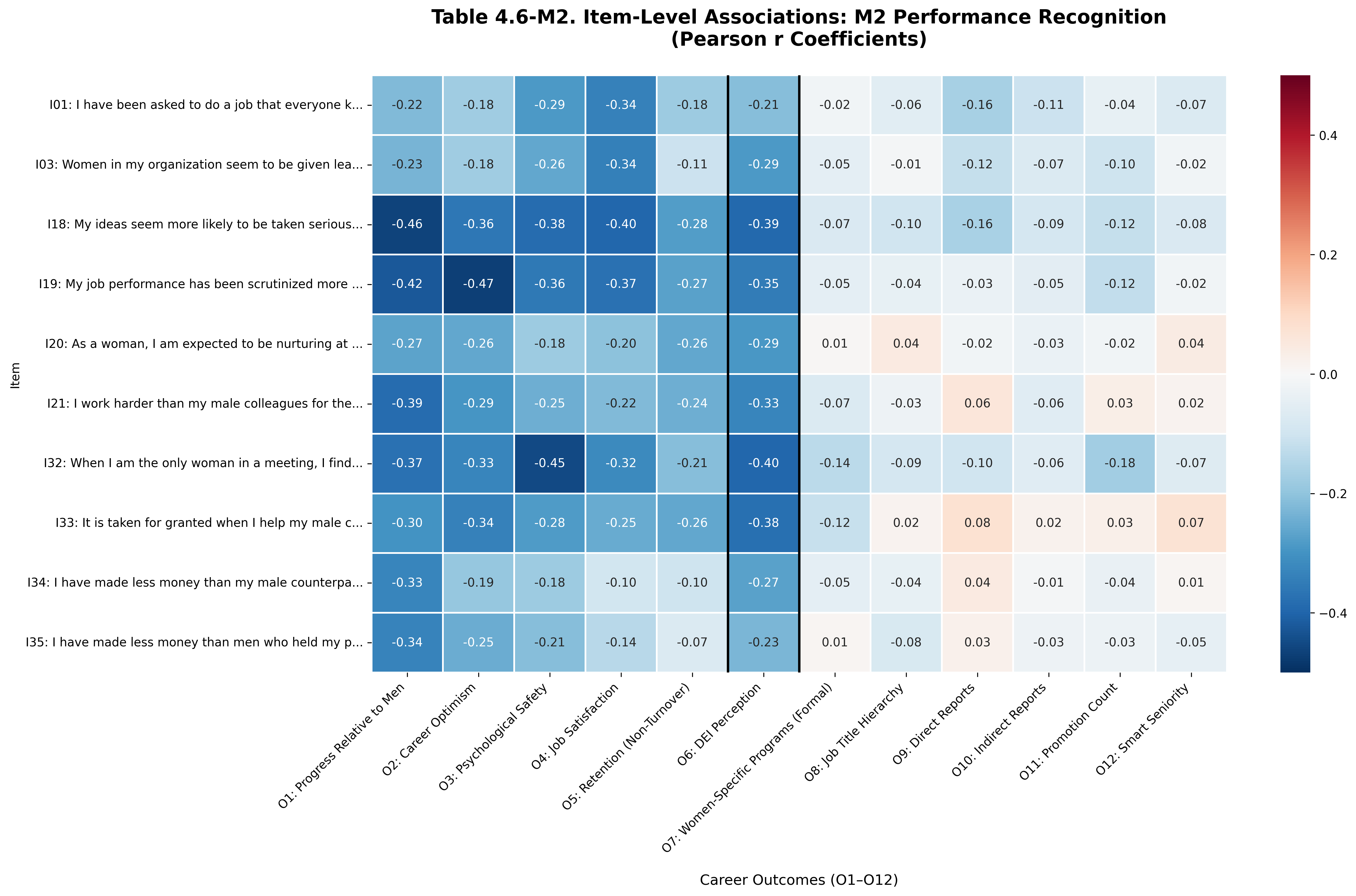
The low mean (1.61) does not mean channeling does not exist. It means the women in this survey were not stopped by it. Women who were successfully filtered out of technical tracks before entering the sector are not in the data. This is direct survivorship bias.
«לבנים יש ג׳ודו לבנות יש ריקוד — לא יכולתי להתאפק. אמרתי: תגידו, אנחנו ב-2023»
"Boys have judo, girls have dance. I couldn't hold back. I said: come on, it's 2023."
— Shira, VP R&D, Stage 1 interview
«מישהי באמת מבריקה... ואמא שלה ממש: לכי תלמדי, תהיי מנהלת משאבי אנוש. בחורה יכולה להיות מפתחת מבריקה — גם משאבי אנוש זה טוב, אבל למה מראש למסגר את זה לשם?»
"A truly brilliant young woman, and her mother says: go study, become an HR manager. A woman can absolutely be a brilliant developer. HR is also fine, but why frame it that way from the start?"
— Shira, VP R&D, Stage 1 interview
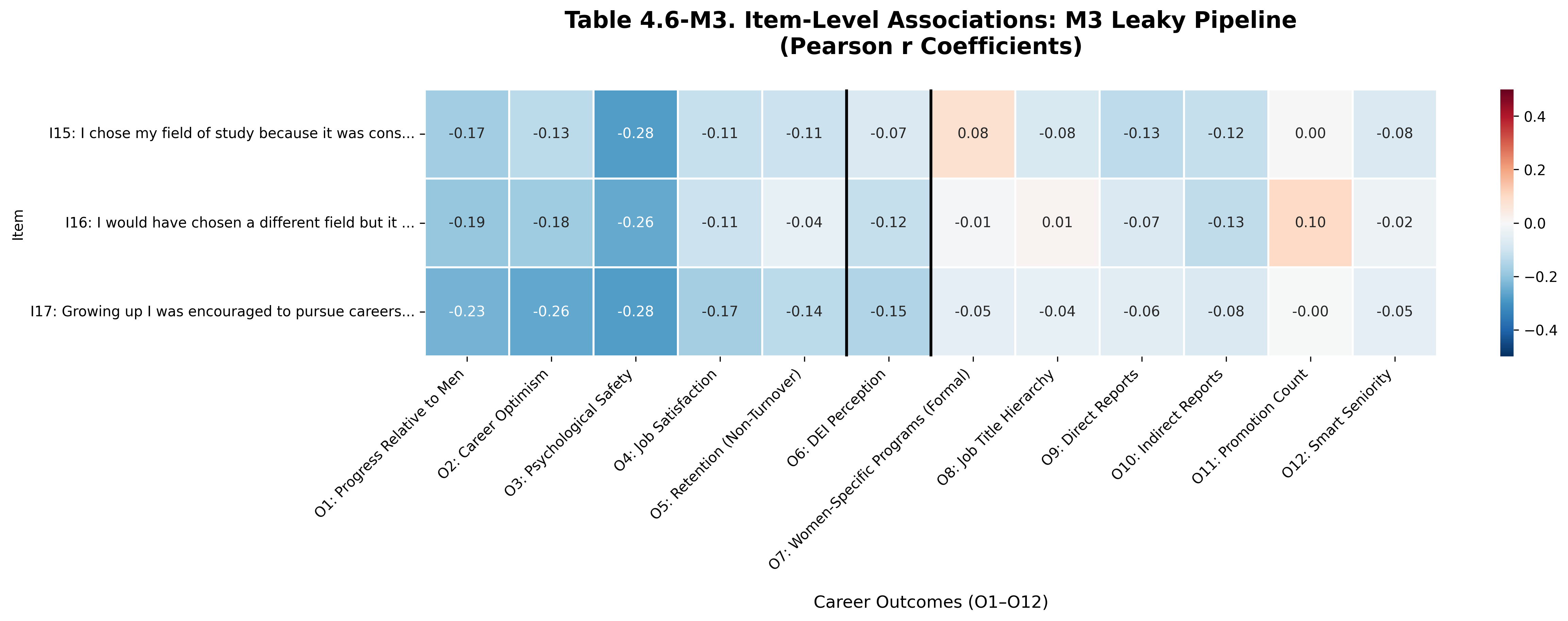
Many Israeli high-tech organizations were built, in culture, structure, and informal practice, around male patterns of leadership, work, and socializing. This mechanism has the broadest outcome footprint in the Stage 2 data.
«יש הרבה כאילו נסיון לדייברסיטי, אבל אם אני רוב הזמן האשה היחידה בחדר, אז אולי בכלל יש דייברסיטי בחברה, אבל בחטיבה אליה אני שייכת — אין דייברסיטי בכלל»
"There is a lot of pretend effort at diversity. But if I am most of the time the only woman in the room, then maybe the company overall has diversity, but the division I belong to has none at all."
— Survey participant, Stage 2
«אני לא יודעת אם לא הייתי מספיק ענוותנית, לא מספיק נחמדה — לא גרמתי לו להרגיש גבר גדול וחזק. ואני לא מסוגלת לעשות את זה»
"I don't know if I wasn't humble enough, not nice enough. I didn't make him feel like a big, strong man. And I'm not capable of doing that."
— Chana, senior manager, Stage 1 interview
| Item | Mean | Top box |
|---|---|---|
| Item 6: "Decisions in my organization are made by men" | 3.43 | 56.4% |
| Item 5: "People assume top leaders will be men" | 2.86 | 36.8% |
| Item 31: "Men interrupt me when I speak" | 2.68 | 24.2% |
| Item 2: "I was blamed for problems outside my control" | 2.64 | 34.1% |
| Segment | M4 Mean | n | Note |
|---|---|---|---|
| On-site | 3.133 | 25 | d=0.52** vs. hybrid |
| Hybrid | 2.701 | 187 | baseline |
| Fully remote | 2.483 | 8 | lowest |
ANOVA: F=3.36, p=0.036. On-site vs. hybrid: t=2.46, p=0.015, d=0.52 (medium). Physical presence = greater exposure to male-built environment.
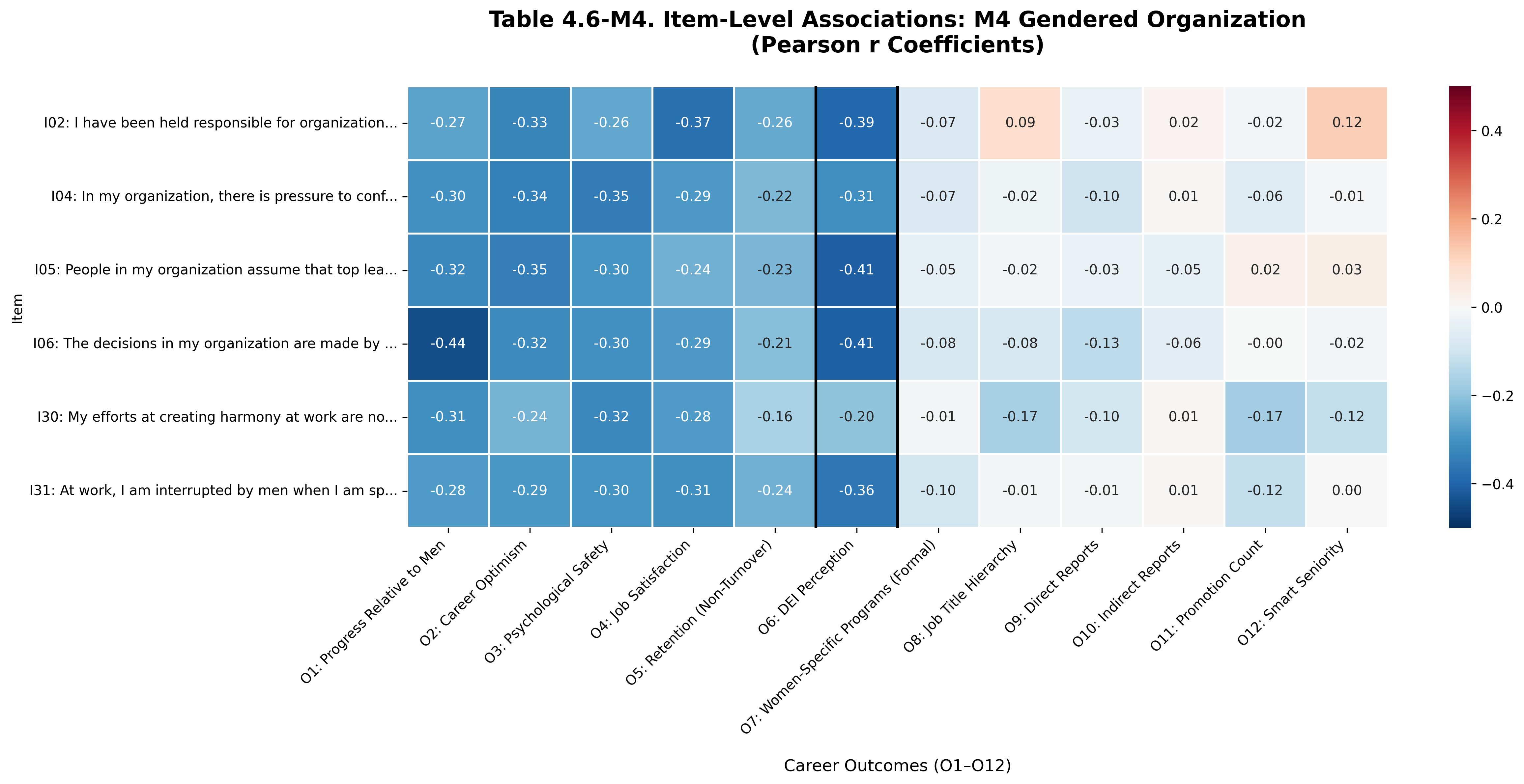
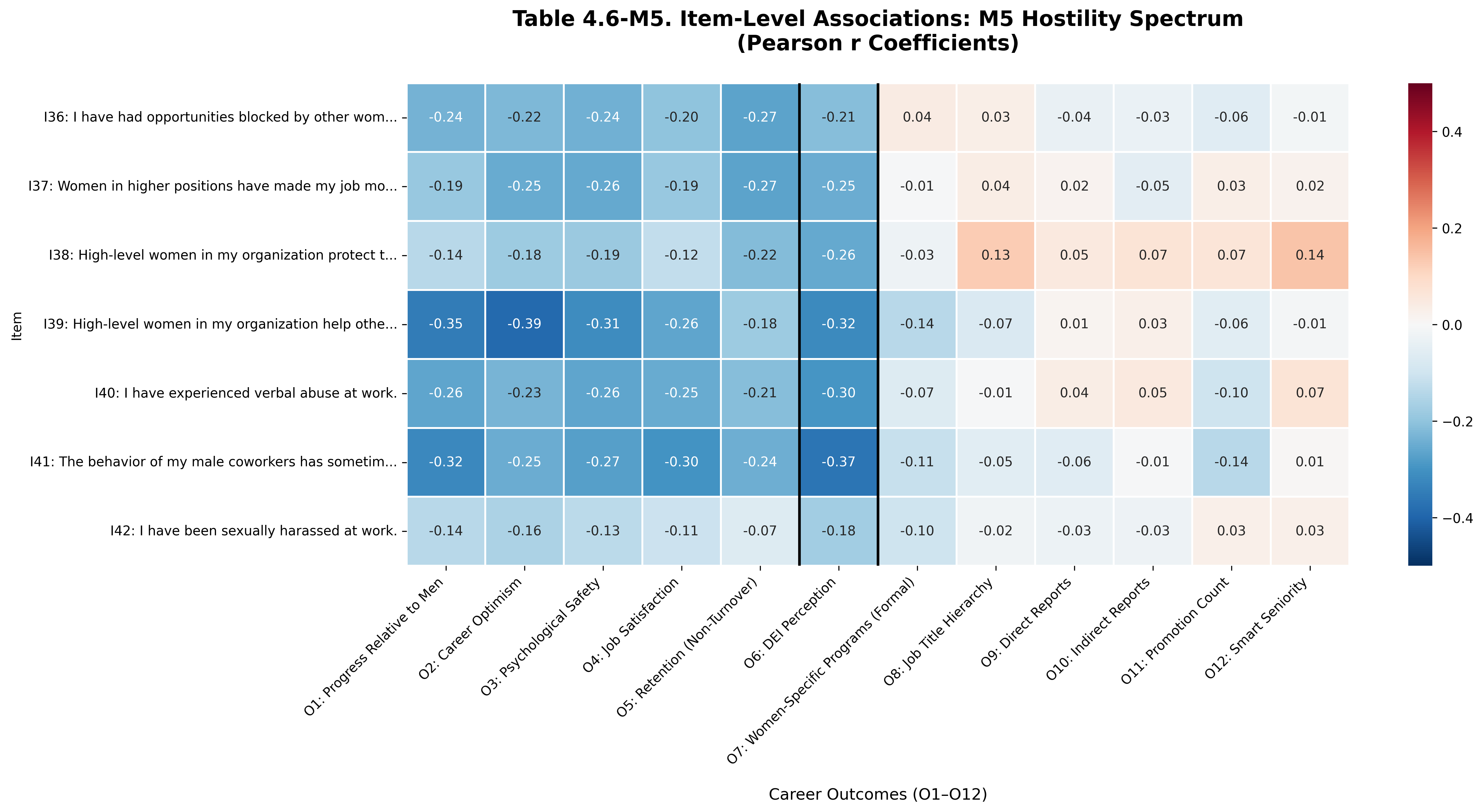
M5 covers two phenomena: (1) Queen Bee Syndrome, senior women creating barriers for other women; and (2) hostile climate, from rare sexual harassment through environmental discomfort and micro-aggressions.
«הם לא מודעים לכך שהבחירה שלהם בנושאי שיחה, בילויים בגיבושים אחרי העבודה ומניירות דיבור, גורמים לי להרגיש חוסר נעימות»
"They are not aware that their choices of conversation topics, after-work activities, and speech patterns make me feel uncomfortable."
— Survey participant, qualitative response, Stage 2
| Factor / Item | Mean | Top box |
|---|---|---|
| Queen Bee factor (Items 36-38) | 2.51 | |
| Item 41: "Male colleagues' behavior made me uncomfortable" | 2.99 | 43.2% |
| Item 42: "I experienced sexual harassment at work" | 1.49 | 7.3% |
| Domain | M5 Mean | n |
|---|---|---|
| Biz/Ops | 2.641 | 39 |
| Tech Adjacent | 2.623 | 50 |
| Core Tech | 2.402 | 131 |
F=3.61, p=0.029. Core Tech vs. Biz/Ops: d=-0.39; Core Tech vs. Tech Adj: d=-0.36. Biz/Ops environment is less technically structured and has greater interpersonal exposure.
«אני מרגישה שהארגונים שהכי מדברים על קידום נשים וזכויות נשים הם בפועל הכי מיזוגנים ומדירים נשים»
"The organizations that talk most about advancing women are in practice the most misogynistic and exclusionary."
— Survey participant, qualitative response, Stage 2
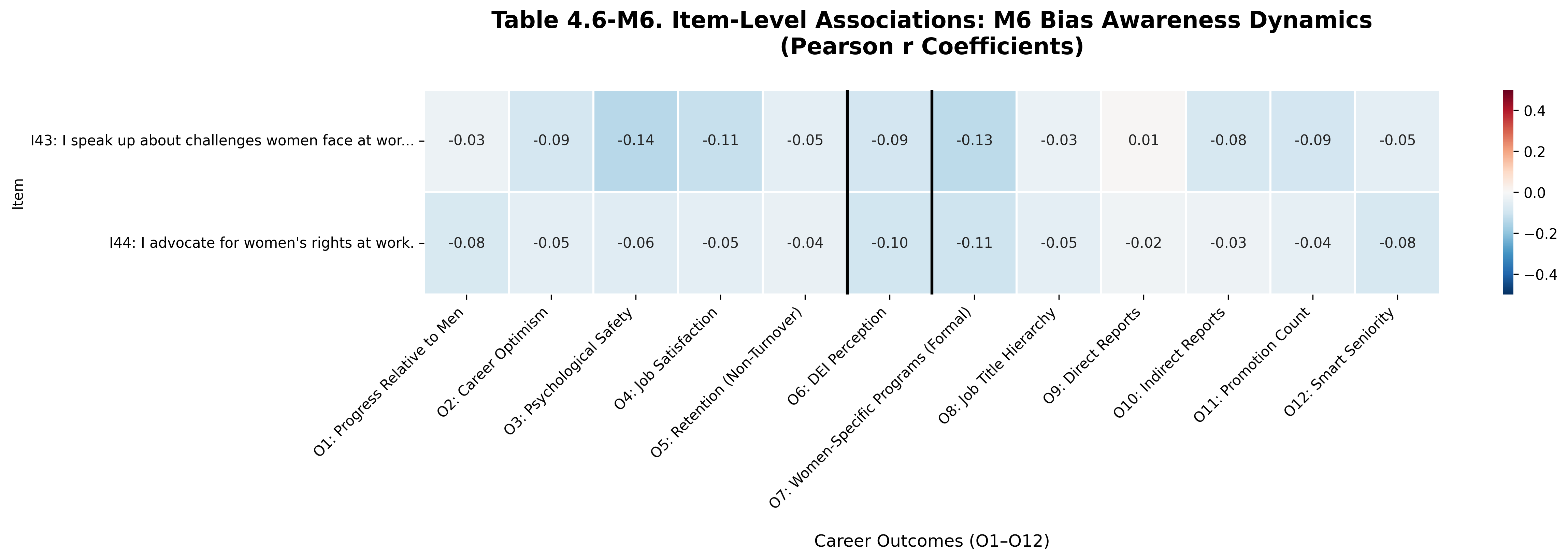
M6 has near-zero direct statistical effect in the regression data. However, M6 may function as a moderator: organizations with high genuine awareness may attenuate the effects of other mechanisms. This is an analytic hypothesis for Stage 3.
| Item | Mean | Top box |
|---|---|---|
| Item 43: "I express my views on challenges women face" | 3.16 | 39.9% |
| Item 44: "I act on behalf of women's rights at work" | 2.86 | 32.0% |
The items measure personal voice expression. The gap between perception and action is itself a finding.
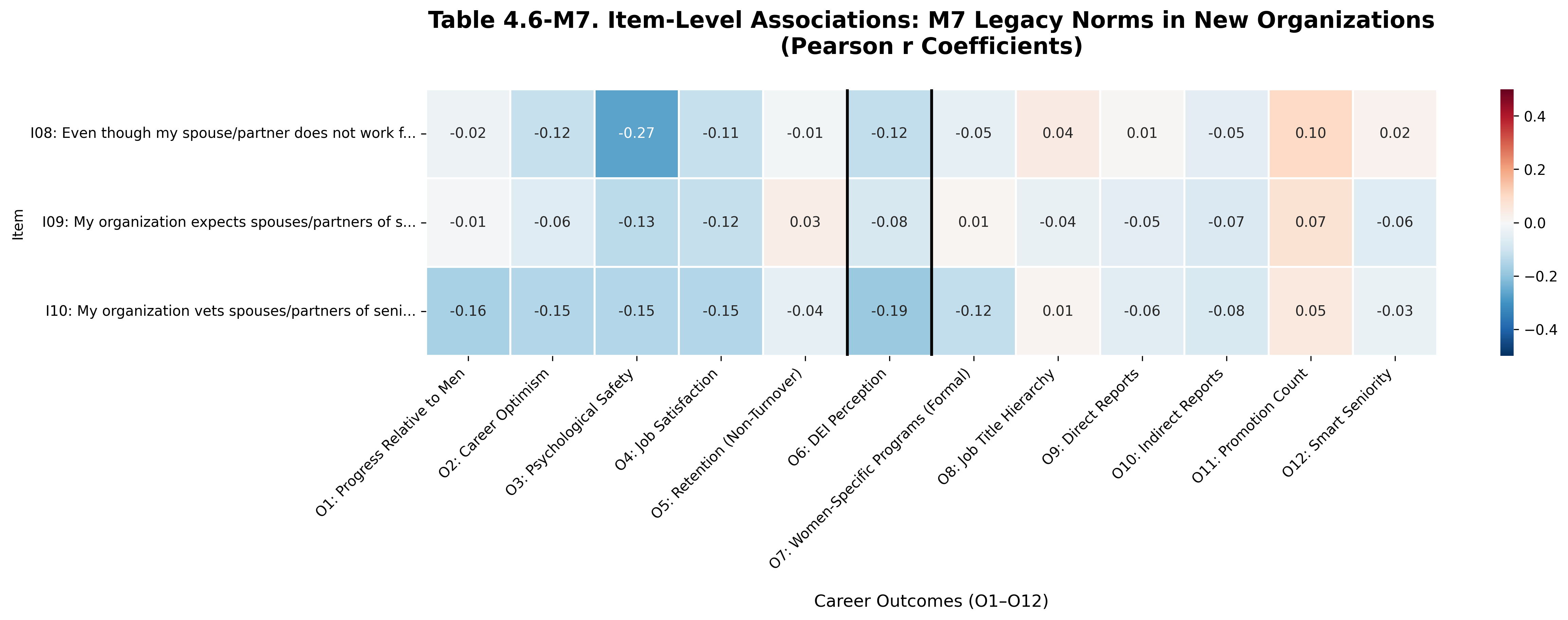
M7 captures the two-career structure: three items test whether organizations expect a senior manager's spouse to host events, support social obligations, and run the household. In this sample, endorsement is very low (M = 1.37-1.45). The formal practices have closed in Israel.
The Israeli form: The structural logic has not disappeared. It has moved from institutionalization to community. Senior women are scrutinized by neighbors and family for domestic presence that male peers are not required to display.
«לפעמים יש שכנות... שנתנו לי את המבטים, זה וזה, את עובדת קשה, לא רואים אותך»
"Sometimes there are neighbors who give you those looks. You work hard, you're never seen."
— Shira, VP R&D, Stage 1 interview
«הפמיניזם הוא קצת חרב פיפיות. כן עושים קריירה, אבל צריכה גם להיות אמא, צריכה גם להיות מבשלת»
"Feminism is a bit of a double-edged sword. Yes, build a career, but you also need to be a mother, you also need to cook."
— Shira, VP R&D, Stage 1 interview
«ובעלי אמר לי: אבל למה ענית כך? אולי דפקת לעצמך את הראיון. ואמרתי לו: בסוף זה לא שאלה ששואלים גבר»
"My husband said: why did you answer like that? Maybe you damaged your interview. And I said: in the end, that's not a question they ask a man."
— Shira, VP R&D, Stage 1 interview
«יש לי 4 ילדים. את שואלת את עצמך רגע מה? ויהיו כאלה שיגידו לך: איך תסתדרי? לא מקדמים אמהות. נטרלתי. אני לא מתיעצת עם קולות כאלה בכלל»
"I have 4 children. You ask yourself, what? And there are people who will say: how will you manage? They don't promote mothers. I neutralized all that. I don't consult voices like that at all."
— Shira, VP R&D, Stage 1 interview
«כל פעם היה ריאורג — פעם אחת כשהייתי בחודש תשיעי ופעם אחת בזמן חופשת לידה — ובכל פעם העדיפו לקדם גבר במקומי»
"Every time there was a reorg, once when I was nine months pregnant and once during maternity leave, each time they preferred to promote a man in my place."
— Survey participant, Stage 2
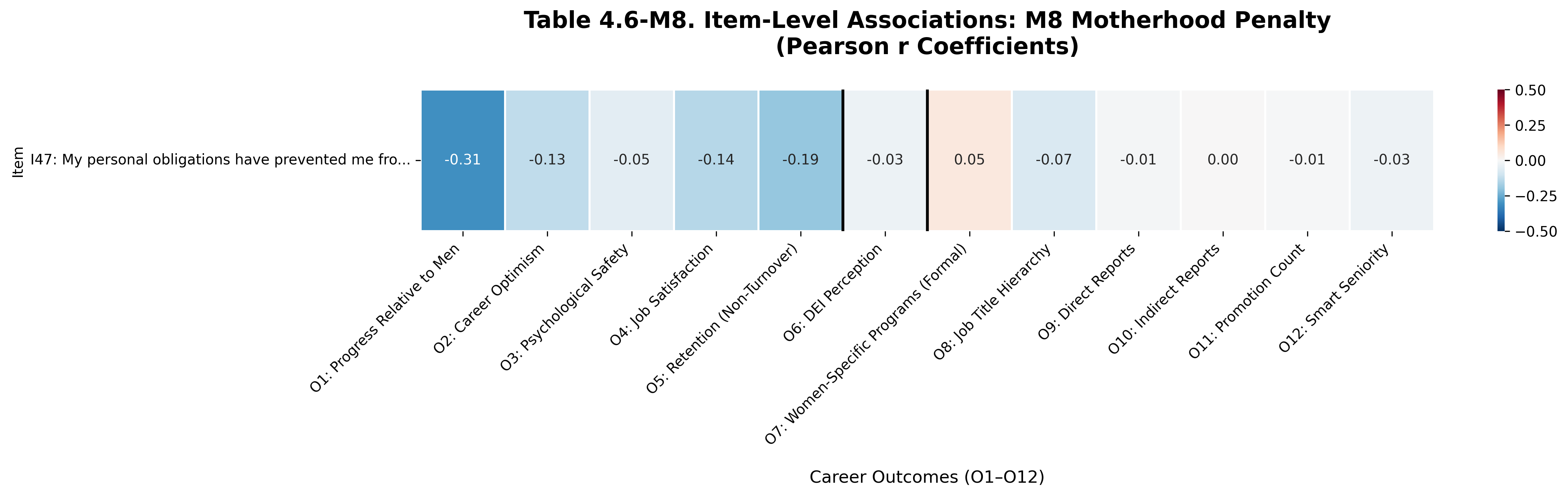
| Item | Mean | Top box |
|---|---|---|
| Item 47: "My personal obligations prevented me from pursuing advancement opportunities" | 2.74 | 35.9% |
| Strategy | Impact | Ease |
|---|---|---|
| Return-to-work contract: internal sponsor assigned before maternity leave | H | M |
| Equal parental leave with active encouragement for men to take it | H | H |
| Expanded subsidized childcare (age 0-3) | H | H |
| Legal protection for flexibility, not managerial discretion | H | H |
«האופן המובלע שבו אנחנו תמיד יותר ביקורתיים על נשים ותמיד סלחניים לגברים»
"The implicit way we are always more critical of women and always forgiving of men."
— Survey participant, Stage 2
| Item | Mean | Top box |
|---|---|---|
| Item 11: "I am mindful of how I communicate when exercising authority" | 3.88 | 73.4% | #1 of 47 items |
| Item 13: "I am careful about how I present myself" | 3.28 | 43.8% |
| Item 14: "I downplay my achievements" | 3.05 | 33.3% |
| Item 45: "I need encouragement to take opportunities" | 2.69 | 30.3% |
M9 = response, not cause. In regression: beta~0. Do not ask women to change their communication style. Ask: what organizational conditions make this tax unnecessary?
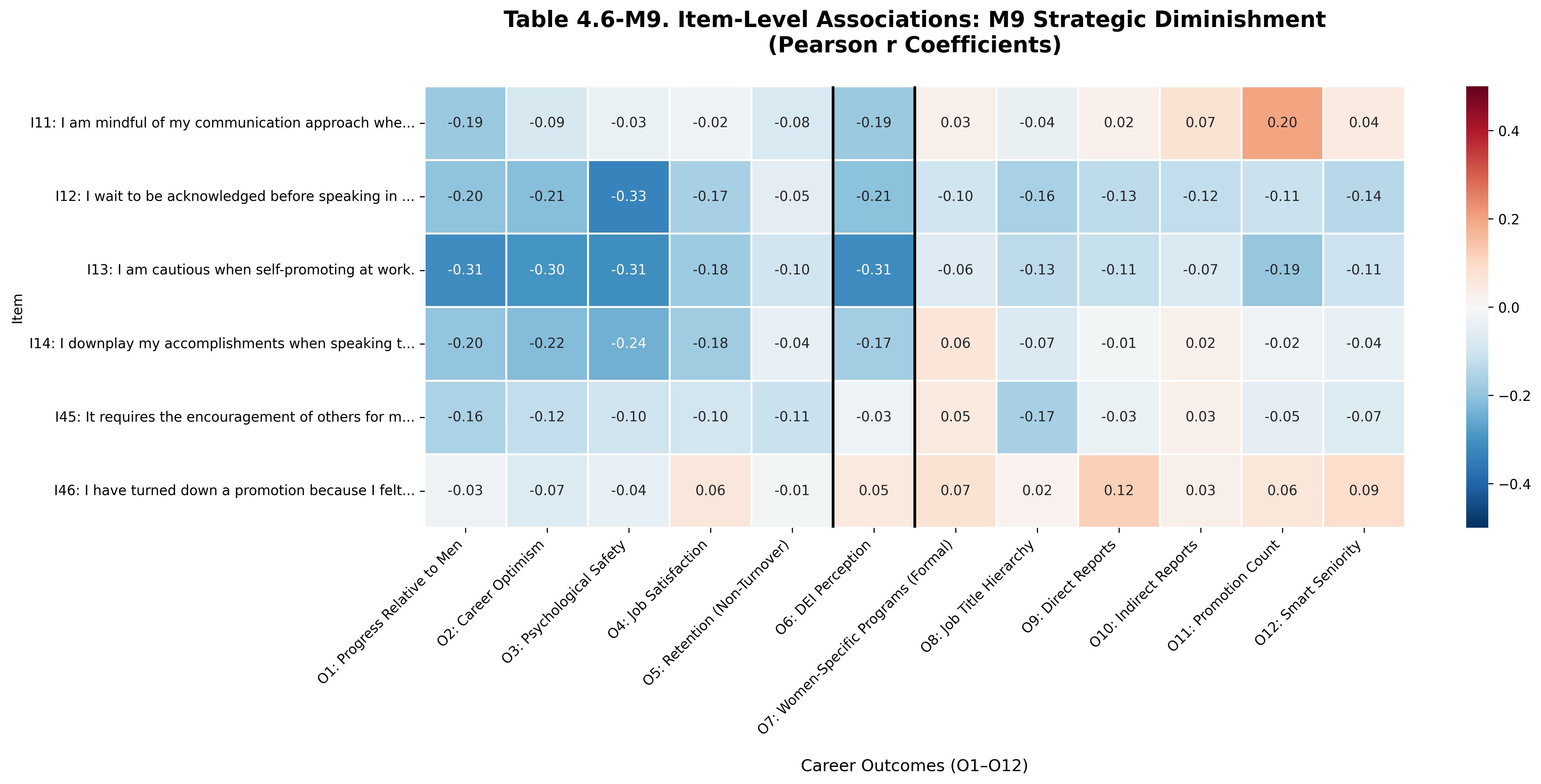
All findings filtered by |Z| ≥ 0.3. Red = segment experiences barrier intensity above average. Blue = below average.
| Dimension | Segment | n | M1 Employment Capital & Access | M2 Performance-Recognition Gap | M3 Leaky Pipeline | M4 Male-Default Organization | M5 Hostility Spectrum | M6 Bias Awareness | M7 Legacy Norms | M8 Motherhood Penalty | M9 Strategic Self-Suppression |
|---|
| Segment | Z-score finding | Interpretation |
|---|---|---|
| On-site (n=25) | M1: +0.38 / M3: +0.54 / M4: +0.46 / M9: +0.46 | Physical presence amplifies exposure to most mechanisms |
| Tech unit background (n=28) | M2: -0.32 / M3: -0.43 / M4: -0.35 / M5: -0.37 / M7: -0.36 / M9: -0.34 | All findings below average; military-technical background buffers multiple barriers |
| Elite unit background (n=37) | M2: +0.34 / M4: +0.40 | The elite unit paradox: "meritocracy" has deeply embedded barriers |
| Solo/Single/Other (n=43) | M1: +0.43 / M4: +0.33 / M7: +0.46 | Without a domestic network, all structural mechanisms are stronger |
| 5+ organizations (n=70) | M1: +0.44 | More experience = increased accumulation of employment capital barriers |
| No children (n=45) | M8: -0.58 / M6: +0.38 | No motherhood penalty, but high awareness of its potential |
Complete during discussion. Save as CSV.
| Strategic idea | What changes | Mechanism | Owner | Impact | Feasibility | Delete |
|---|
75 minutes total. Print-ready.
| Time | Phase | Content |
|---|---|---|
| 0:00–0:10 | Opening | Welcome and ground rules (confidentiality, no right/wrong answers, "I" statements). Intro round: name + one thing you are here to explore. No theoretical framing, one stat to open, space for reaction. |
| 0:10–0:20 | Validation | Present two Stage 2 findings: (1) 73% on Item 11, the voice management tax; (2) the stalling effect, women with higher barriers stay more, not less. Ask: does this resonate? What surprises you? 30 seconds of silence after each finding before opening discussion. |
| 0:20–0:32 | Deep Dive A H1: Institutional Barriers |
M1 + M2 + M3: Access capital, recognition gap, pipeline. Key question: where do you see the access gap most concretely? Not mentors, sponsors. Who is in the room when decisions about you are made? |
| 0:32–0:44 | Deep Dive B H2: Structural & Cultural Barriers |
M4 + M5 + M6 + M7: Male default, Queen Bee, bias awareness, legacy norms. Key question: what does the organization built for men feel like day-to-day vs. in moments of promotion? On Queen Bee: is it choice or reproduction of scarcity? On awareness: what does DEI look like when it actually changes something? On legacy norms: where do community expectations of domestic presence still shape how women are evaluated at work? |
| 0:44–0:55 | Deep Dive C H3: Individual & Internalized Barriers |
M8 + M9: Motherhood penalty, voice management tax. Key question: what conditions in an organization would make the M9 tax unnecessary? What does equitable career continuity through parenthood actually require in Israeli tech? |
| 0:55–1:10 | Strategy | Intervention cards (use strategy table). Each participant ranks top 3 by impact/ease. Discuss: which intervention gets the most "high impact + easy"? What is the first blocker? What would actually move in Israeli tech vs. what sounds good on paper? |
| 1:10–1:15 | Close | Closing round: one thing from today that was missing from the quantitative data. Introduce member checking: participants will receive a findings summary and be invited to respond before the final chapter is submitted. |